

Dermatological Treatments
Nail Disorders and Nail Removal
The nail is often a silent indicator of skin and general health.
Overview
Thickening, yellowing, whitening, ridging, separation or deformity of the nails is not merely a cosmetic issue; it can reflect fungal infection, psoriasis, eczema, trauma or systemic disease.
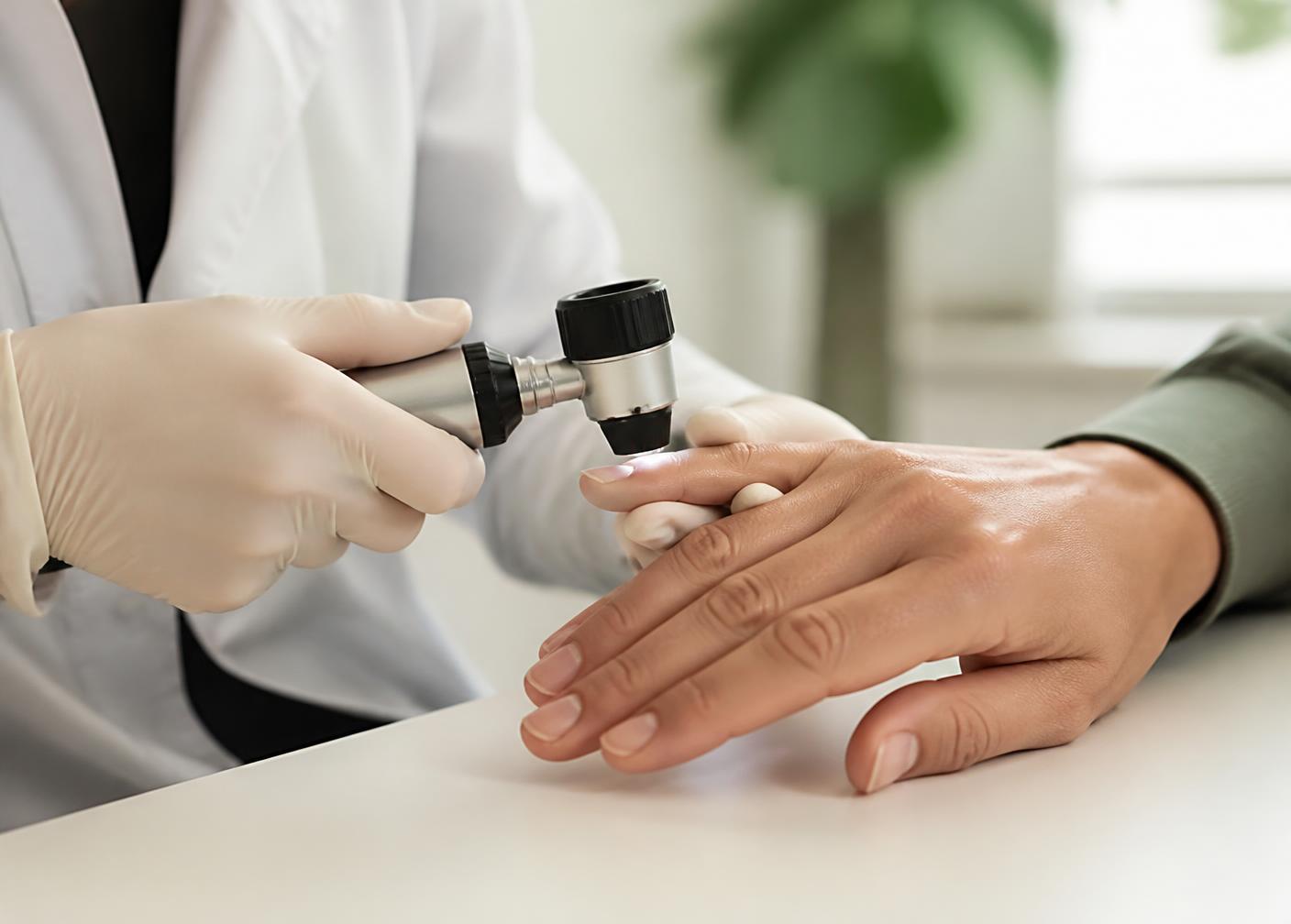
For this reason treatment does not start straight away. A dermoscopic examination is performed first and, if needed, a nail sample is taken for fungal microscopy and culture. Long courses of treatment started before a clear diagnosis usually fail.
Depending on the diagnosis, treatment involves topical or oral medication, edge correction for ingrown nails and, where necessary, partial or total nail removal. Nail removal is performed under local anaesthesia and supported by an aftercare plan to prevent recurrence.
Who is it for?
- Those with thickened, yellowed or brittle nails
- Those with recurring ingrown nails and inflammation at the nail edge
- Those who notice a dark streak or colour change in the nail bed
- Those with pain, swelling or discharge around the nail
- Those with nail involvement due to psoriasis or eczema
Treatment Information
- Examination time
- 20 – 30 minutes
- Removal time
- 20 – 30 minutes
- Treatment duration
- 3 – 9 months
- Culture result
- 2 – 4 weeks

Approach
“The nail is often a silent indicator of skin and general health.”
Dr. Sera Kayhan · Dermatologist
Process
How does the treatment proceed?
- 01
Examination
The nail and surrounding tissue are assessed with a dermatoscope and a history is taken.
- 02
Sampling
If needed, a nail sample is taken for fungal microscopy and culture.
- 03
Treatment
Topical or systemic therapy and edge correction are planned according to the diagnosis.
- 04
Removal and follow-up
In selected cases the nail is removed under local anaesthesia and healing is monitored.
FAQ
About Nail Disorders and Nail Removal
Is nail removal painful?+
The procedure is performed under local anaesthesia, so no pain is felt during it; mild discomfort afterwards is controlled with simple painkillers.
How long does it take for the nail to grow back?+
Fingernails renew completely in about 4–6 months and toenails in 9–12 months.
Can nail fungus be cured with cream?+
Topical treatment can be enough for superficial, limited involvement; widespread cases or those involving the nail matrix require oral therapy.
Do ingrown nails come back?+
They can recur if incorrect nail cutting and tight shoes continue; in recurrent cases a permanent edge procedure can be performed.
Is a dark streak on the nail dangerous?+
Most are harmless, but dark streaks that widen, affect a single nail or spread onto the surrounding skin must always be evaluated.
Dermatological Treatments
Acne and Scar Treatment
A plan that stops active acne and gradually repairs scars.
View →Rosacea
A control plan for persistent redness, visible capillaries and sensitivity.
View →Diagnosis and Treatment of Skin Diseases
Skin health, barrier repair, and revitalization protocols.
View →Pigmentation Treatment
Personalized protocol for melasma, sun spots, and post-inflammatory marks.
View →Nevus (Mole) Monitoring and Removal
Dermoscopic mole checks, digital monitoring and surgical removal when needed.
View →